
Tackling climate change requires more than good intentions – it requires reliable, accessible, meaningful data.
Climate change is not short of information. It is short of usable information – data that is trustworthy enough to act on, open enough to reach the people who need it, and structured well enough for both humans and machines to make sense of it. That gap, more than any shortage of good intentions, is what Neuroclima was built to close. At Neuroclima, we see data not just as information, but as a resource that can unlock smarter climate decisions, foster innovation, and empower stakeholders.
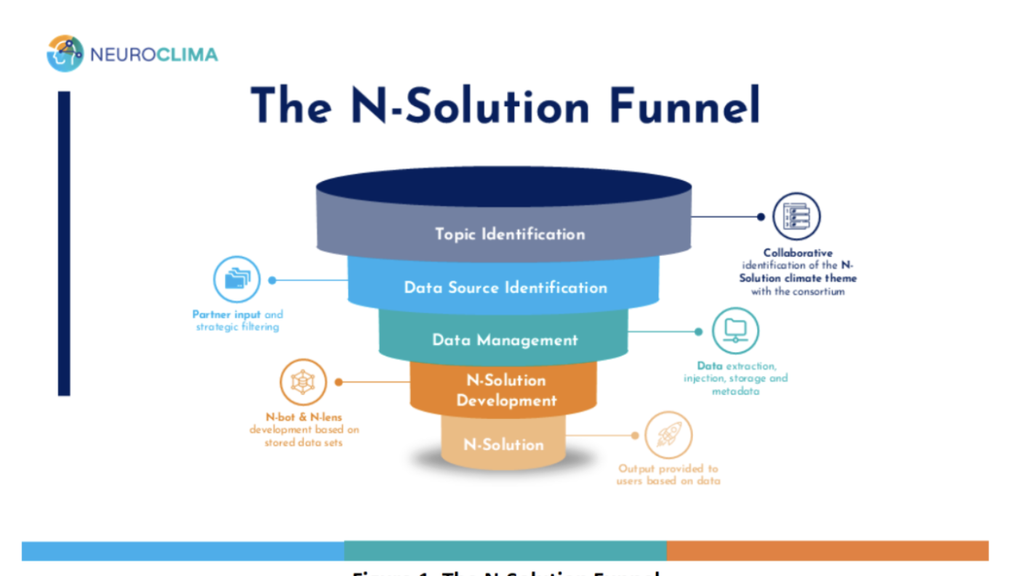
Our approach to data management is designed to turn raw information into actionable climate intelligence. At the heart of this work lies a structured framework we call the N-Solution Funnel: a step-by-step process, as described in Figure 1, to identify, filter, and prepare the most relevant climate data for use in the NEUROCLIMA solution.
Four categories of data flow through it:
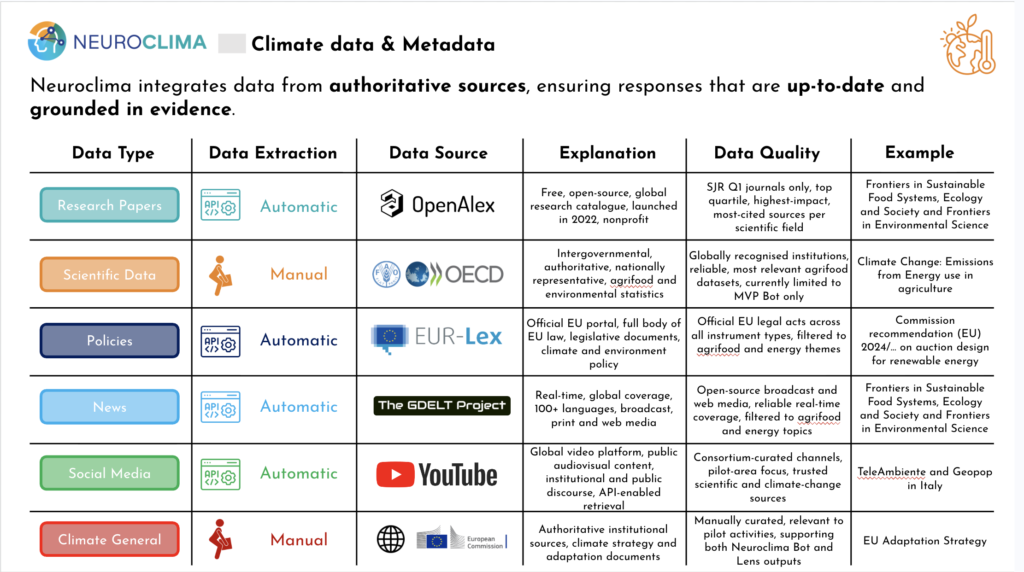
● Climate Data: science-based datasets, research papers, news, policy documents, social media (and more) that provide trusted knowledge on climate challenges.
● Metadata: structured information that makes datasets findable and usable, following the FAIR principles (Findable, Accessible, Interoperable, Reusable).
● Social Tipping Point Data: shaped to train the Neuroclima solution to recognise events or signals that may trigger systemic behavioural shifts in society.
● Pilot Data: real world evidence arising from Neuroclima’s pilot activities (e.g., observation log and content generated in Neuroclima’s Deliberate platform)
Data Selection Methodology: Applying the Funnel Approach
With the thematic scope defined – covering agrifood, energy, and water scarcity – a structured four-step methodology was applied to identify and select data sources, ensuring the use of only trusted, science-based information.
Following the N-Solution Funnel approach, this process began with the broad collection and categorisation of diverse theme-related data into four main types: Research papers, social media (YouTube), news articles, policy documents, scientific datasets and climate general documents (authoritative institutional sources, climate strategy and adaptation documents such as the EU Adaptation Strategy)
To maintain data quality and relevance, a strategic filtering process was implemented at each stage of the funnel, allowing the project to avoid unnecessary storage costs and focus exclusively on high-value data. A central priority was placed on selecting open-access sources and rigorously verifying each source’s licensing to ensure full compliance with Creative Commons 4.0. This guarantees that all data feeding the Neuroclima solution is both legally open and freely accessible. For every data source identified, the specific licence was documented to ensure compliance with the obligations each licence requires.
As a concrete example of our commitment to transparency and data quality, we collect as metadata the SCImago Journal Rank (SJR) of the journal in which each collected research paper was published. While we do not filter sources based on SJR – as valuable insights can emerge from a broad range of journals – we use this indicator to enhance the transparency of the solution’s outputs. For instance, when the Neuroclima solution generates a response, it can indicate that the answer was informed by research published in high-ranking journals with high SJR scores, giving users greater confidence in and visibility over the scientific quality of the underlying evidence
Bringing Social Tipping Points to life
Not all change in climate adaptation happens gradually. Sometimes a single, well-placed shift – a new policy, a piece of innovative technology, or a change in how people perceive a risk – is enough to break through the economic, cultural or informational barriers that have kept a community or sector stuck in old habits. When that happens, it can set off a rapid, self-reinforcing cascade: one shift in behaviour or institutional practice leads to another, until adaptive practices become embedded across an entire community or sector. This is what researchers call a Social Tipping Point (STP), and understanding how to spot one early and reliably, is central to what Neuroclima is trying to build.
To bring the concept of Social Tipping Points to life, an STP Taskforce was built within the consortium to define a clear set of qualifying criteria based on literature. These include the presence of environmental problems with recognised societal consequences, a shared social awareness of those problems and a collective understanding of their causes and effects. Building on this foundation, the team worked together to create an initial collection of 100 confirmed examples, which became the training material used to teach the artificial intelligence how to recognise these patterns in practice. Before relying on the technology at scale, the task force carried out a careful validation phase, comparing the AI’s judgements against those of human experts to check that the results were both accurate and meaningful.
This process allowed the criteria and the underlying models to be refined together, ensuring the system reflects genuine social dynamics rather than surface level patterns. From this foundation, a complete pipeline was developed that takes in large amounts of information, prepares it, and then guides it through several automated stages that identify, describe, and explain each Social Tipping Point. All of this work culminated in the STP Document Analyser, a user friendly tool that allows people to upload documents and automatically discover the Social Tipping Points contained within them, making this complex analysis accessible to anyone using the platform.
Overall, as part of our ongoing efforts to automate data collection powering the Neuroclima solution, we are prioritising data that are genuinely valuable for Neuroclima and its users – ensuring that every source contributes meaningfully to the quality, reliability, and transparency of the climate intelligence delivered.
Building intelligence people can rely on
None of this – the funnel, the filtering, the validation, the transparency around every journal rank and every licence – is incidental to Neuroclima’s mission. It is the mission, carried out one dataset at a time.
As the project continues to refine and automate how it gathers and prepares information, the underlying commitment stays constant: every piece of data that reaches the platform should earn its place, contributing directly to the quality, reliability and transparency of the climate intelligence Neuroclima puts into the world.

