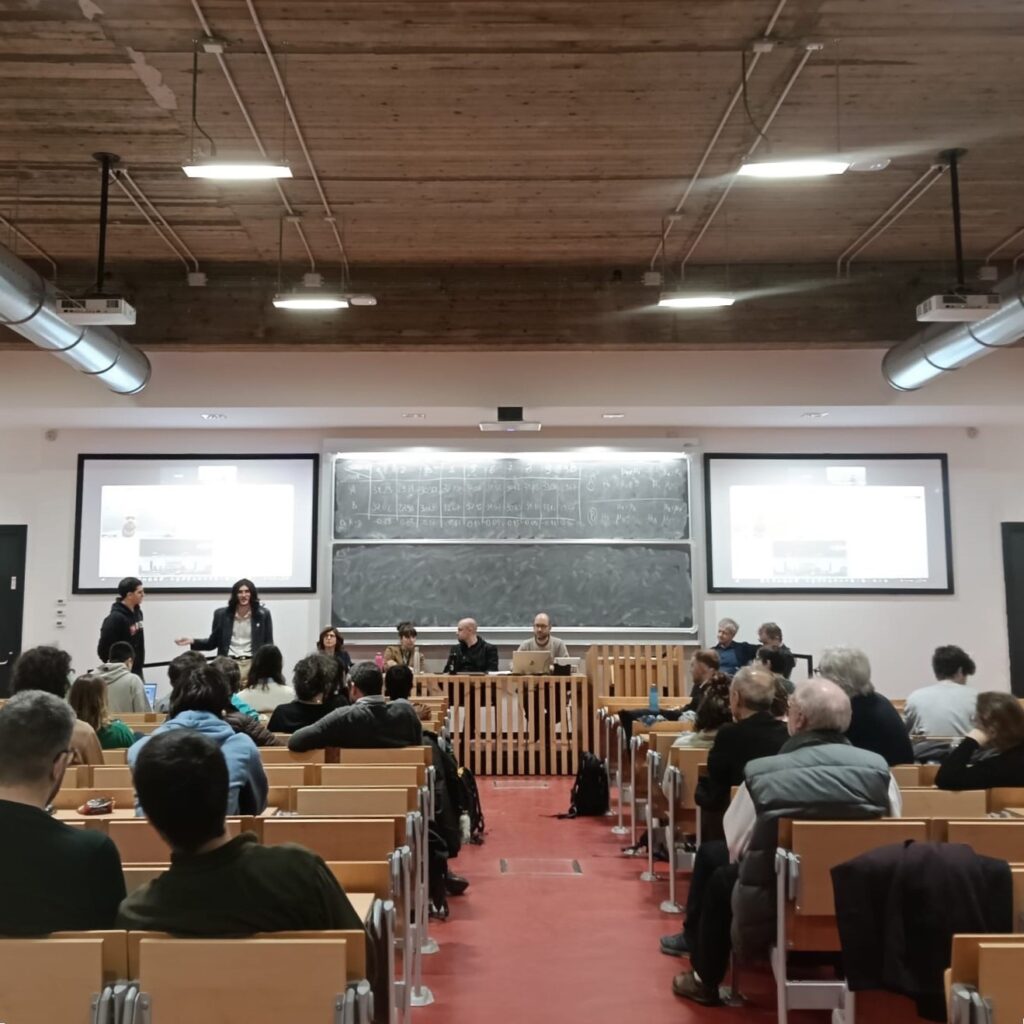
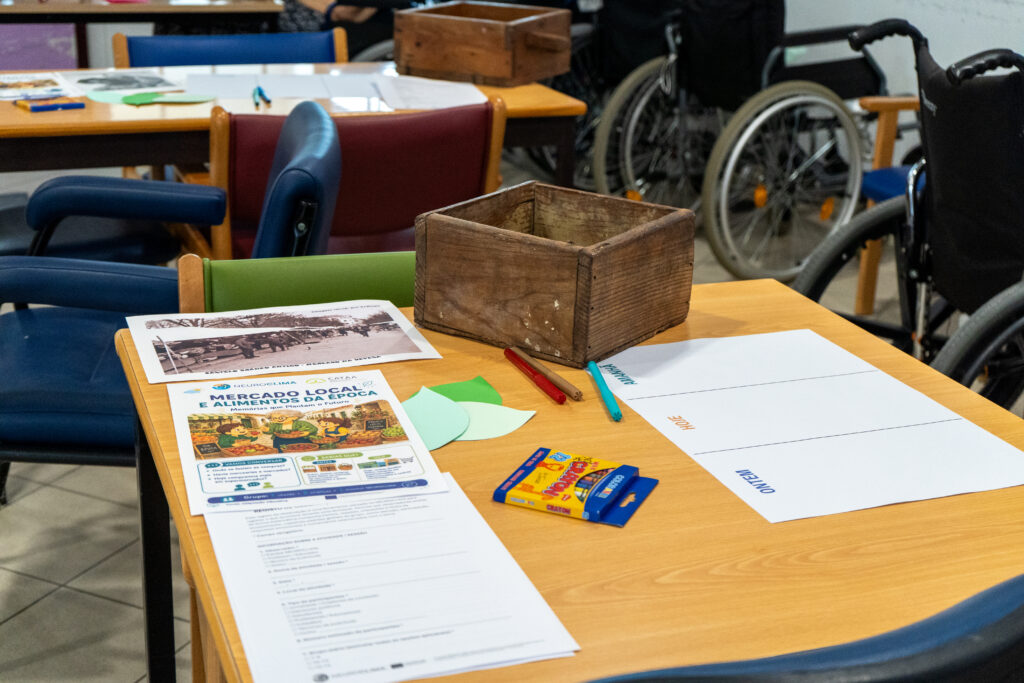
Before the pilot series opened its doors, NEUROCLIMA’s partners asked a harder question. What would it take for people to trust, use and genuinely shape climate action tools powered by AI? Deliverable D7.7 is their answer: a field guide to experimental civic participation.
A French student poster, reproduced alongside Sherry Arnstein’s famous 1969 essay on citizen participation, conjugates a single verb: je participe, tu participes, il participe, nous participons, vous participez… ils profitent. I participate, you participate, we all participate… and they profit.
The joke has survived more than half a century. It names a risk in every participatory process: consultation that looks inclusive but keeps power unchanged. And climate action is not immune to this danger. Research cited in the report finds civic engagement on climate is too often fragmented. It remains mostly top-down and hard to access, often feeding apathy among citizens. These patterns keep people on the sidelines of decisions that shape their lives.
NEUROCLIMA builds a hybrid human-AI decision-support system to avoid that trap. The project aim is to serve as a nervous system for climate action resilience, signaling between citizens, policymakers, and institutions. Deliverable D7.7, Experimental Approaches in Civic Participation, offers groundwork for testing that ambition in the real world.
Two pilots, two very different audiences
The report prepares two pilots that put NEUROCLIMA’s tools in the hands of the people they are meant to serve.
Pilot 1 puts an AI monitoring tool in front of journalists, content creators and policymakers. The questions are practical: does it surface the right content and trends? Is it fast and reliable? And, perhaps most telling, do people keep coming back to it once the novelty wears off?
Pilot 2 is about climate literacy and creative expression. Educators and students explore blended learning that weaves in games and interactive storytelling, while youth groups and citizens take part in workshops where writing, film and other creative media become ways to articulate their own concerns and ideas about climate change.
Five experiments in giving people a real seat at the table
Rather than a single recipe, D7.7 sets out a toolbox of five experimental approaches, each tested elsewhere and adapted to NEUROCLIMA’s goals.
- Scenario-based participatory design. Communities work through realistic situations, such as a flood or a heatwave, using maps, simulations and role-play to set their own priorities and identify workable solutions.
- Gamification and role-play. Participants step into the shoes of a policymaker, an activist or a local stakeholder, experiencing first-hand the trade-offs behind climate decisions. Games such as Climate Interactive’s World Climate Simulation show how play can make complex negotiations tangible.
- Creative expression platforms. Citizens turn personal experience into films, stories and artworks, then share them through exhibitions and online platforms. Emotion, the report argues, is not a distraction from climate understanding but a route into it.
- Citizen science and participatory mapping. People collect environmental data themselves, from air quality readings to flood hotspots, then interpret it together with experts. Ownership of the data becomes ownership of the decisions it informs.
- Multi-channel digital engagement. Face-to-face sessions are combined with online spaces, multilingual support and accessibility features, so that distance, language or disability no longer decide who gets a say. Barcelona’s Decidim platform is one of the reference points.
Underpinning all five is a deliberate choice of theory. Archon Fung’s Democracy Cube helps map who participates, how they communicate and how much influence they really have. Asset-Based Community Development shifts the starting point from what communities lack to what they already have: networks, knowledge and local resources. Deliberative democracy adds structured, fair dialogue such as citizen juries. Together they move participation up Arnstein’s ladder, from being consulted to holding real influence.
Four tests: how do you know participation is working?
Good intentions are not a metric. D7.7 defines four criteria against which every tool and activity will be judged.
- Accuracy. Do the tools deliver precise, reliable results that people can act on? For an AI tool, that means checking its outputs against validated benchmarks, not just asking users whether they look right.
- Accessibility. Can anyone use them, regardless of technical skill or physical ability? Task completion rates, navigation errors and time spent resolving problems all tell the story.
- Inclusivity. Who is actually in the room? Demographic tracking by age, gender, background and geography reveals whether participation reflects the communities affected, or only the usual voices.
- Trust. Do people believe their data is safe, the process is fair and the results are reliable? Beyond questionnaires, the report proposes observing behavior itself: whether participants speak openly, share feedback and would recommend the tools to others.
These are measured through a mix of surveys, focus groups, interviews, usability testing and before-and-after learning assessments, so that numbers and lived experience are read side by side.
Drawing on input from the partners running the pilots, the document also lists the risks openly: tools people find hard to use, workshop participants who lose interest, tight budgets, communication gaps between facilitators and participants, low survey response rates, and the danger that results are not adopted once the project ends. The proposed remedies include building communities of teachers who train their peers, starting with student-led assemblies, and connecting with existing citizens’ climate assemblies and sister EU projects such as ORBIS, NetZeroCities, KT4D and Democratic Odyssey.
A reference for researchers and practitioners
D7.7 is written for the project’s pilot teams, but it is also offered as a reference for researchers and practitioners anywhere who face the same challenge: making civic engagement on climate inclusive, measurable and trusted. Its central lesson is simple and widely applicable. Meaningful participation does not happen by accident. It has to be designed, tested and measured as carefully as any piece of technology.
The groundwork laid in D7.7 now feeds NEUROCLIMA’s pilots across six countries.
However, journalists, policymakers, educators, students and citizens are testing the project’s tools, including Learn and Play.
What they discover will shape how those tools evolve in climate action.
And whether the poster’s punchline can finally be rewritten: nous participons, nous décidons.