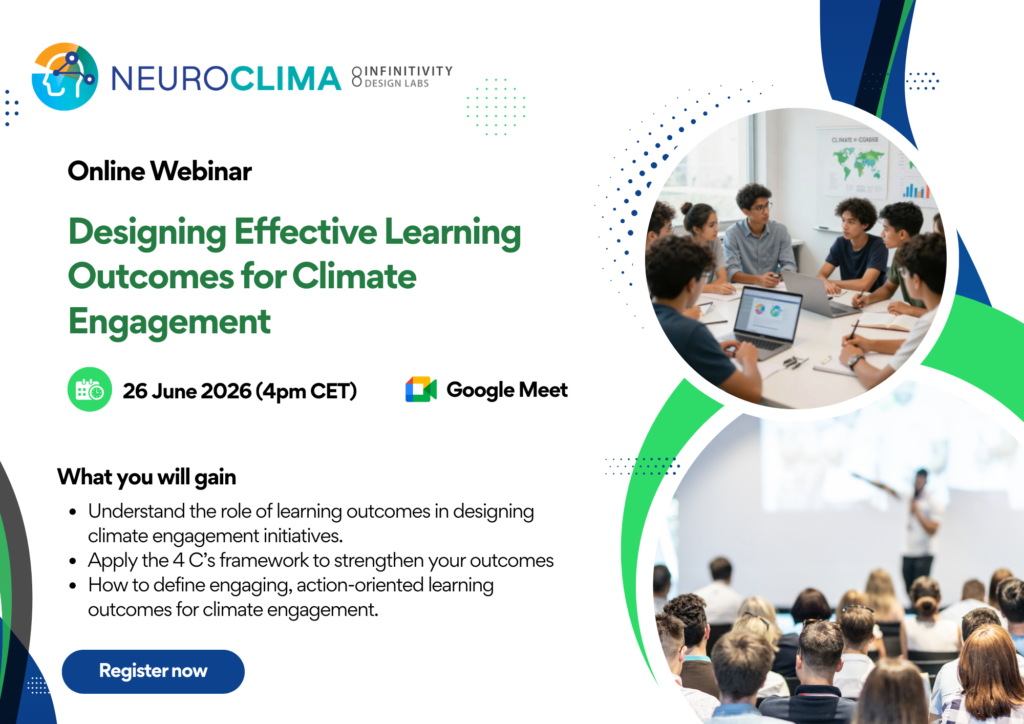
Ask a local councillor where to find reliable data on regional drought risk, and you will likely be met with an honest shrug.
The research exists. So do the policy papers, European directives, and breaking news reports. But this critical information lives in fragmented silos, speaks different technical languages, and rarely arrives in a usable format when an actual decision needs to be made. Climate adaptation is no longer a distant future concern; it is a daily operational challenge for the people who teach, report on, study, and legislate for our communities.
To close that gap, NEUROCLIMA spent the last three years building a unique nervous system for climate action. One of its key outcomes is the NEUROCLIMA Hub, a suite of AI-driven and human-centered tools designed to turn scattered climate evidence into practical lessons, sharp news stories, and resilient public policies.
Five Tools, One Ecosystem
Rather than offering a single, one-size-fits-all platform, the Hub approaches climate engagement through five interconnected tools:
- Lens: A centralized search engine tailored specifically for climate adaptation. It pools scientific research papers, regulatory frameworks, and news coverage into a single repository.
- Bot: A conversational AI built on top of Lens. Instead of generating vague, paraphrased summaries, journalists and testers in recent pilots praised its ability to retrieve and cite direct passages from original reports, ensuring complete source transparency.
- Deliberate: A collaborative framework meant to structure complex environmental discussions, helping groups weigh evidence and find common ground on contentious local issues.
- Play: An interactive storytelling module where learners navigate real-world scenarios—spanning agri-food systems, energy, water management, disinformation, wildfires, and behavioral change—by making choices and watching the consequences unfold.
- Learn: A comprehensive e-learning platform equipped with advanced analytics so educators and organizations can deliver structured courses and track engagement over time.
Designed for the Real World
The Hub’s resources are built for immediate application. They are split into tools (standalone frameworks, templates, and downloadable assets) and activities (facilitated group exercises complete with step-by-step instructions and clear learning objectives).
Crucially, the ecosystem targets four distinct pillars of society:
- Educators looking to build evidence-based lesson plans that foster genuine critical thinking.
- Students engaging with hands-on climate missions and interactive simulations.
- Journalists and creators needing quick access to verified data to craft accurate public narratives.
- Policymakers and legislators who must balance hard scientific evidence with community sentiment when drafting climate regulations.
Bridging Research and Action
None of these tools are designed to replace human judgment. Their purpose is far more practical: ensuring that when someone sits down to write a policy, teach a classroom, or report a story, the best available evidence is only a click away.
The NEUROCLIMA project wraps up its core development phase this year, and its pilots are currently being tested across European newsrooms, classrooms, and local councils.
You can explore the ecosystem, test the tools, and find resources tailored to your work at https://hub.neuroclima.eu/