From a crowded Milan fair to a storm-scarred Alpine valley, a Tuscan wine town and Genoa’s waterfront, NEUROCLIMA’s Italian pilots asked one question: what happens when people stop being lectured about climate and start being asked?
Climate policy is usually designed from the top down: global models, satellite data, international targets. Yet adaptation is lived from the ground up, in kitchens, classrooms, farms and town halls. Over the past months, Politecnico di Milano, lead partner of the EU-funded NEUROCLIMA consortium, took the project’s citizen-centred toolkit on the road across Italy to test that idea in practice.
The result is six pilots in six very different settings: a sustainability fair, a high school, a mountain festival, a forest walk, a harbour district and a historic hill town. Each used a different tool, from QR-coded playing cards to sticker canvases, AI-generated images, the NEUROCLIMA Bot and a trade-off card game. Together they tell one story: people are not tired of talking about climate, they are tired of being talked at.
Here is what we learned, stop by stop.
Fa’ la cosa giusta!
At Milan’s sustainability fair “Fa’ la cosa giusta!”, POLIMI researchers set out ten playing cards, each carrying a QR code linked to a different take on the Milano Cortina 2026 Winter Games. Visitors drew one blind and landed on anything from a Greenpeace critique to an upbeat video on green investment, a mountain blogger’s dispatch or a political commentary.
After reading or watching, they left a short reflection on Deliberate, the NEUROCLIMA platform’s public deliberation tool. No votes, no right answers. Many said they had never linked artificial snow to water consumption; others felt “conflicted” or admitted they had changed their minds.
The takeaway: a concrete, local story beats abstract global data. Participants said they now understood the difference between climate information and contextualised information.
Read the full story: The Great Olympic Snow Job [LINK]
Bertarelli-Ferraris High School
On 19 May 2026, Professor Maximiliano Ernesto Romero and Professor Florillo turned a fifth-year class of 11 students and 3 teachers into a living lab. Students first explored energy sources through the gamified NEUROCLIMA Play platform, followed by a briefing anchored in the IEA’s World Energy Outlook.
Then agency shifted to the students. One group imagined a day in a fully decarbonised Milan in 2040, focusing as much on social norms and habits as on technology. The other role-played local authorities, youth activists, companies and NGOs negotiating renewable infrastructure and municipal budgets.
The takeaway: young people approach the transition with optimism, and they grasp the trade-offs of democratic policymaking fast when they are handed the roles.
Read the full story: Co-Designing the Energy Transition with NEUROCLIMA at Bertarelli-Ferraris High School [LINK]
Cevo, Corpo e Montagna Festival: from Storm Vaia to an Alpine future
From 30 May to 1 June, NEUROCLIMA set up a living lab at the Casa del Parco Adamello. This is a valley still marked by Storm Vaia, which in October 2018 flattened around 14 million trees across north-eastern Italy, and by the steady drain of rural depopulation.
In the first exercise, Osserva (Observe), visitors reacted with sticky notes to eight mountain images, some real and some AI-generated. Words like “Vaia”, “devastation” and “forest management” filled the boards. In the second, Proponi (Propose), they built their ideal resilient mountain on a blank canvas with stickers of wildlife, trails, renewables and community spaces.
The takeaway: adaptation is an emotional and cultural negotiation tied to landscape identity. Wind turbines and solar panels sparked an open, constructive debate about protecting the look and heritage of the peaks.
Read the full story: From the Scars of Storm Vaia to Alpine Resilience [LINK]
The story of a storm
Also at the Corpo e Montagna Festival, a second experiment swapped the seminar room for a hiking trail. Facilitated by local trainer Veronica Vismara (PignaMentis), residents, visitors and regional stakeholders walked from the Casa del Parco Adamello to Lampoma Farm, which sat directly in Vaia’s path.
At the farm, four groups became “environmental detectives”, each reconstructing the storm through a different lens. One read local newspaper coverage, one audited institutional websites, one interviewed the farm manager, and one questioned the NEUROCLIMA Bot, the project’s AI-based information tool.
The takeaway: the same storm told a different story depending on the medium. Climate resilience depends as much on how critically we read information as on the science itself.
On 28 July 2026, NEUROCLIMA and POLIMI’s Department of Design took the conversation to the sea. At the Genova Blue District, “Quella bottiglia era mia” (“That bottle was mine”) started from a simple premise: every piece of plastic in the ocean carries a human story.
The free, open-entry evening combined screenings of the short films One Ocean and Verso il Mare, a participatory storytelling workshop and an open Q&A with climate and design experts Francesca Garaventa and Federico Borromeo. It was co-organised with Genova Blue District, One Planet One Future, Interreg Europe, Comune di Genova, CNRS and Legambiente Liguria.
The takeaway: changing our environmental future starts with understanding how we got here, one personal story at a time.
See the event announcement [LINK]
Negotiating resilience in Montepulciano
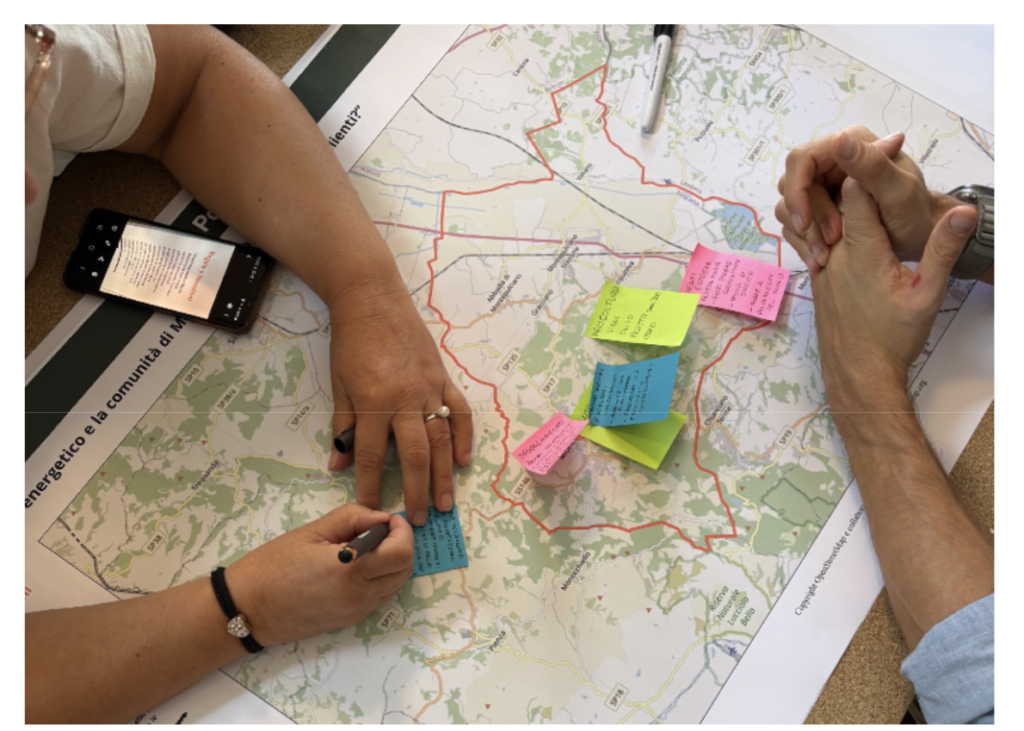
On 23 September, the Sala Ex Macelli hosted “Community Lens: Visualizing & Negotiating Local Resilience”, run with the Municipality of Montepulciano, energy experts Fedabo and the benefit company Territori Sostenibili. Officials, residents, tourism operators and people designing the local energy community mapped the town as one system where water, energy, mobility, tourism, agriculture and landscape are linked.
Then came the trade-off game cards developed by POLIMI with Fedabo. With a limited budget in credits, two groups decided what to fund now and what to defer. Both backed renewable energy communities, lower consumption and accessible mobility. One put water management first; the other prioritised energy independence but drew a firm line at agrivoltaics and, for some, rooftop solar.
The takeaway: communities are not resisting the green transition. They are resisting top-down solutions that ignore local identity, landscape and human scale. As one participant put it: “Water is fundamental; without water, we do nothing.” The debate now continues online on Deliberate.
Read the full story: Negotiating Local Resilience and Climate Realities in Montepulciano [LINK]
What Italy taught us
Six pilots, six audiences, and three lessons that kept coming back:
- Local beats global. A storm people remember, a bottle they once held or a roof they own moves the conversation further than any planetary statistic.
- People want to deliberate, not be lectured. Given space for a nuanced thought instead of a slogan, participants questioned their own assumptions and, often, changed their minds.
- The transition must be co-authored. From Cevo’s peaks to Montepulciano’s vineyards, support for climate action depends on respecting landscape, identity and local voice.
These insights now feed back into the NEUROCLIMA framework and toolkit, as pilots continue across Europe.
Subscribe to the NEUROCLIMA Newsletter for updates about our pilots