
Can interactive co-design and behavioral science empower the next generation to drive the European green transition? To find out, you have to move past top-down climate data and listen directly to the aspirations, frictions, and values of young citizens.
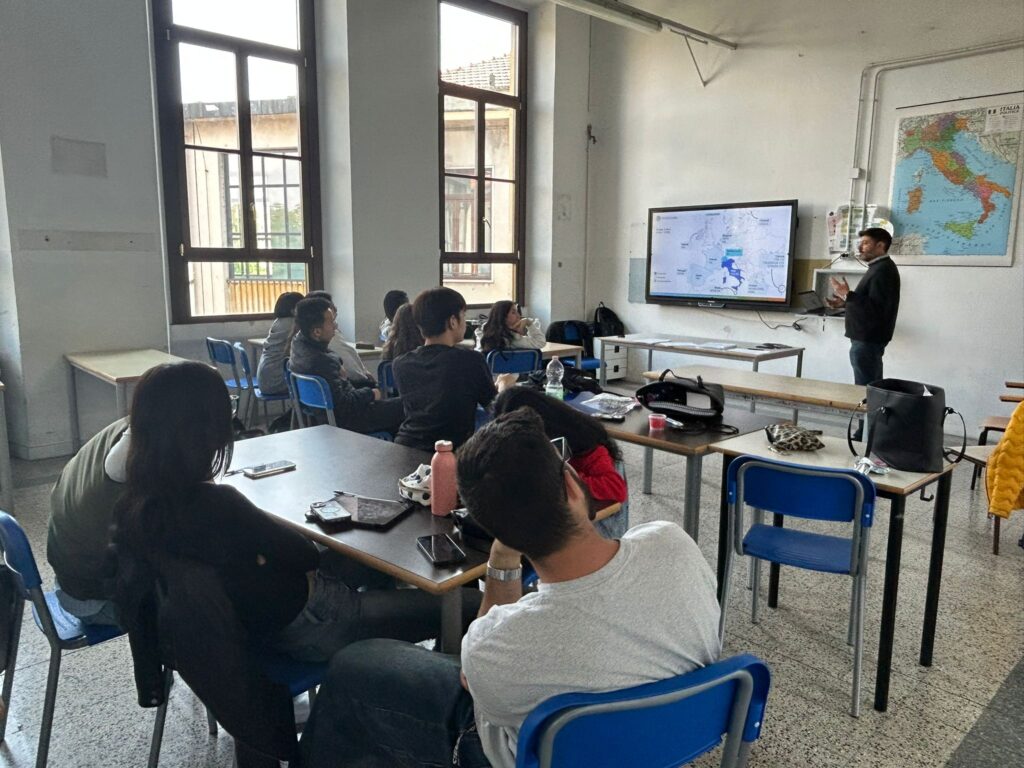
On Tuesday, May 19th, 2026, the EU-funded NEUROCLIMA project brought its citizen-centered framework directly into the classroom. Led by Politecnico di Milano’s Professor Maximiliano Ernesto Romero and coordinated alongside Professor Florillo, the session deployed an intensive educational and participatory living lab at the Bertarelli-Ferraris High School in Milan. The activity engaged a fifth-year class of 11 students and 3 teachers in a series of interactive experiments designed to explore how individual behaviors intersect with global climate policies.
The pilot kicked off by baseline-mapping the classroom’s existing attitudes toward sustainability. Through a specialized pre-session questionnaire, the NEUROCLIMA research team captured initial student perceptions regarding energy systems, green policies, and personal accountability.
With the baseline set, students were introduced to the core philosophy of NEUROCLIMA: treating climate adaptation not just as a cold engineering problem, but as a bidirectional communication highway between citizens and institutions.
To bridge complex global data with everyday reality, the students logged into the NEUROCLIMA Play platform. Moving through an immersive, gamified digital story, the class tracked the real-world trajectories, social costs, and environmental footprints of different global energy sources. This digital narrative set the stage for an in-depth lecture anchored in the International Energy Agency’s World Energy Outlook, detailing greenhouse gas emission targets, the scaling of renewables, and the profound leverage points where individual choices alter macroeconomic energy trends.
The core of the workshop shifted agency entirely to the students. Divided into two active working groups, the class utilized tools from the NEUROCLIMA Toolkit to co-create and debate the boundaries of climate governance.
Envisioning the 2040 Sustainable Horizon
The first group was challenged with a future-oriented scenario-building exercise. Transported to the year 2040, students mapped out a typical day in a completely decarbonized Milan. They redesigned their housing, future mobility networks, and school environments.
Rather than focusing strictly on technology, their discussions highlighted the changing social norms, emotional adjustments, and everyday habits required to sustain an eco-conscious society. The resulting canvas revealed a fundamentally optimistic outlook—one where environmental awareness and collective responsibility seamlessly support technological innovation.
Navigating Trade-offs in a Simulated Policy Arena
A second group stepped directly into the shoes of systemic actors for a simulated policy debate on local energy governance. Roleplaying as local authorities, grassroots youth activists, corporate leaders, and environmental NGOs, the students fiercely negotiated the implementation of green policies.
The exercise brought real-world friction points to light, forcing students to debate the complex trade-offs of deploying localized renewable energy infrastructures and managing municipal budgets. The simulation successfully cracked open the dense, multi-faceted nature of democratic policymaking, sharpening the students’ negotiation, systemic thinking, and collaborative problem-solving skills.
The session closed with the students presenting their visual 2040 roadmaps and policy agreements back to the collective class, drawing clear, operational lines between personal behavior and institutional mandates.
Before departing, the students completed a post-activity questionnaire. By analyzing the shifts between the pre- and post-session data, the NEUROCLIMA research team will evaluate exactly how interactive co-design and gamified learning alter an individual’s sense of climate agency and literacy.
The high levels of engagement witnessed at Bertarelli-Ferraris High School underscore a core pillar of the NEUROCLIMA mission: Europe’s transition to a resilient, climate-neutral future cannot be dictated solely from executive offices in Brussels or Milan. To trigger a genuine social tipping point, climate policies must be co-authored by the very people who will inhabit the future.

