
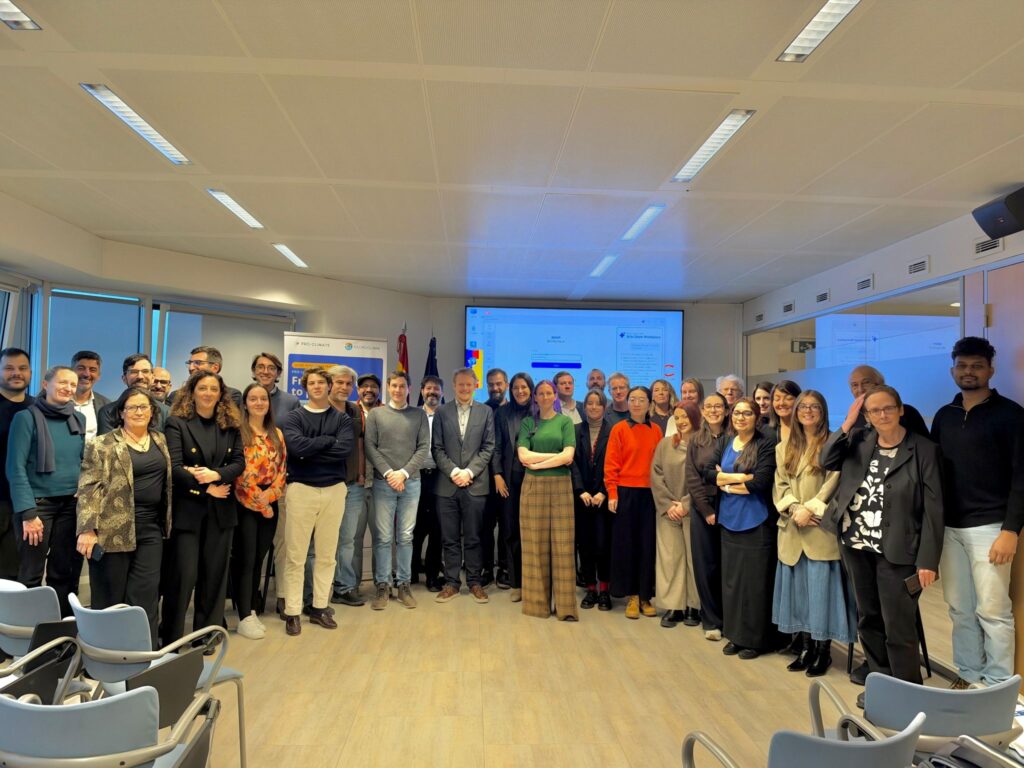
Europe has never had more climate science, sharper models, or better policy roadmaps—yet across the continent, adaptation still hits a wall the moment it meets everyday life. That contradiction sat at the heart of “From Behaviour to Policy,” a joint conference in Brussels on 25 November where two Horizon Europe projects—NEUROCLIMA and PRO-CLIMATE—compared notes after three years of independent work. Across three sessions spanning human behaviour, digital tools, and governance, one diagnosis kept returning: adaptation rarely fails for lack of science. It falters where people struggle to make sense of change, communities cannot organise, and institutions stall.
Hosted at the CSIC Brussels Office, the gathering brought together dozens of participants from 20 countries across academia, EU institutions, civil society, NGOs, industry, and the media. After welcome remarks from project coordinators Prof. Maximiliano Romero for NEUROCLIMA and Iason Tamiakis for PRO-CLIMATE, the morning opened with two addresses that framed the stakes from opposite ends of the problem. Margarita Ruiz-Ramos of DG Research & Innovation set out the European policy backdrop, pointing to the growing weight of climate resilience in EU policy—from the 2026 State of the Union address to the newly launched European Framework on Climate Resilience, its Navigator of tools, and upcoming National Resilience Plans toward 2030. Resilience, she underlined, is bound up with energy and food security, economic prosperity, and social stability.
Erika Staël von Holstein, Chief Executive of Re-Imagine Europa and the European Narratives Observatory (NODES), followed with the keynote “Bridging the Sense-Making Gap: What Narrative Science Means for Climate Policy”. She argued that people do not process climate change as a scientific data spreadsheet. They are emotional beings who interpret change through identity, sense of fairness, and belonging. When climate measures feel like a punishment, a hidden cost, or a threat to livelihoods, resistance hardens—even when the underlying science is rock solid.
That tension carried into the first session, on the human approach, chaired by Beatrice Gobbo of Politecnico di Milano. Drawing on PRO-CLIMATE’s six living labs—Bergen, Sligo, Gdańsk, Leipzig, Badajoz, and Zakynthos—Xu Liu of Atlantic Technological University showed how co-creation gains traction when local authorities are actively involved from the start, early practical wins build trust, and continuity is planned before project money runs out. Irini Theodorakopoulou of the Co-opAbility Institute looked at how communities organise and where local adaptation systems run into friction, mapping governance bottlenecks such as fragmented departmental responsibilities, power imbalances, uneven use of evidence, and short funding cycles. Working alongside local “change agents” over three years, Prof. Dr Ann-Marie Nienaber of AMN Consultancy Ltd and Dr Kindy Sandhu of Coventry University stressed that shifting habits and governance routines takes sustained trust-building, peer support, and room for local ownership rather than top-down directives.
NEUROCLIMA speakers approached the human side through social tipping points, emotion, and data curation. Pierre Rossel of Inspiring Futures set out a human-centred framework for environmental social tipping points, examining how shifts in perception, shared causal understanding, and social dynamics can tip norms—or leave communities stuck. Lamprini Ntountoumi of IASIS spoke on moving from social tipping points to digital support while addressing climate anxiety, grief, and “eco-paralysis,” sharing insights from pilots in Greece with journalists, policymakers, educators, youth workers, and citizens using creative methods such as cinematherapy, bibliotherapy, storytelling, and art. Dante Adami and Nicolò Ferriani of PredictBy then explained how the N-Solution funnel combines human judgment and consortium expertise with automated pipelines and FAIR data principles to curate tens of thousands of documents and tens of thousands of AI-identified candidate social tipping point passages.
Over a light lunch, attendees moved between conversations and research posters from both projects before turning to the afternoon’s second session, on supporting technologies, chaired by Theodora Kousta of Novelcore. Here the question was how digital tools can help practitioners make decisions without pretending technology alone solves politics.
Tassos Kanellos of ITML presented NEUROCLIMA’s integrated architecture—conceived as a “Climate Nervous System”—and the NEUROCLIMA Hub, with single sign-on access, a catalogue of 62 tools and activities, and role-based pathways for policymakers, journalists, and educators. He also demonstrated NeuroClimaLens for tracing evidence, sources, social tipping points, and knowledge graphs alongside Deliberate discussions. Prasasthy Balasubramanian of the University of Oulu walked through NeuroClimaBot and the backend STP Analyzer, showing how retrieval, knowledge graphs, multilingual support, reading modes, and source traceability are built to make curated climate knowledge easier to interrogate. For classrooms and community work, Jennifer Nolan and Aideen Fitzsimons of FIPL presented Learn, Play, the physical Climate Quest board game, and participatory toolkits tested across Ireland, Portugal, Greece, Cyprus, and Italy with 193 educators, 54 youth workers, more than 2,200 students, and over 1,500 citizens, surpassing initial reach targets.
PRO-CLIMATE’s session contributions zoomed in on municipal decision-making. Ivan Puga-Gonzalez of NORCE, David Herbert of the University of Bergen, and Aleksandra Lazović-Lonningen of the University of Bergen introduced the project’s multi-agent model and open platform, before Puga-Gonzalez and Herbert tested three “what-if” scenarios from the living labs—exploring how stakeholder networks, priorities, and local council voting dynamics interact in places like Badajoz and Sligo.
The final session of the day, on results and policy-related issues, chaired by Berta Mitzei of CEPS, brought those findings back to institutional reality. Inês Brandão and Ines Barreto of CATAA shared pilot validation results for NEUROCLIMA’s integrated solution across six countries, pairing pre- and post-survey gains in self-perceived climate literacy and willingness to act with qualitative observations from classrooms and communities that show how people actually respond in practice.
Policy speakers pressed on what holds back wider action. Christina Deligianni of TRUENIQUE pointed to three years of lessons on institutional conditions amid fast-shifting policy agendas, transition anxieties, and disinformation, arguing for stable frameworks, inclusive participation, and stronger links between citizen input and decisions. Alexander Yendell of Leipzig University set out PRO-CLIMATE’s six local policy papers and European policy paper—developed with local stakeholders across the quadruple helix—calling for multi-year institutional backing, practical support for smaller municipalities, ongoing public engagement, and closer attention to political culture and trust.
As the conference wrapped up in Brussels, the takeaway was clear enough to carry past the closing slide. Both projects are publishing their results and policy recommendations in the coming weeks, and the two sides are also working on a joint eight-chapter book due out early next year. None of it offers a silver bullet—but it does point to where the real work begins: meeting people where they are, and fixing the institutions meant to act with them.
To follow upcoming publications and releases from NEUROCLIMA, subscribe to the project newsletter at neuroclima.eu/subscribe-neuroclima-newsletter.

