How do you build a community climate strategy when the trauma of an environmental crisis is already etched into the landscape? For the mountain communities of northeastern Italy, climate change isn’t an abstract prediction for the year 2050—it is a lived history.
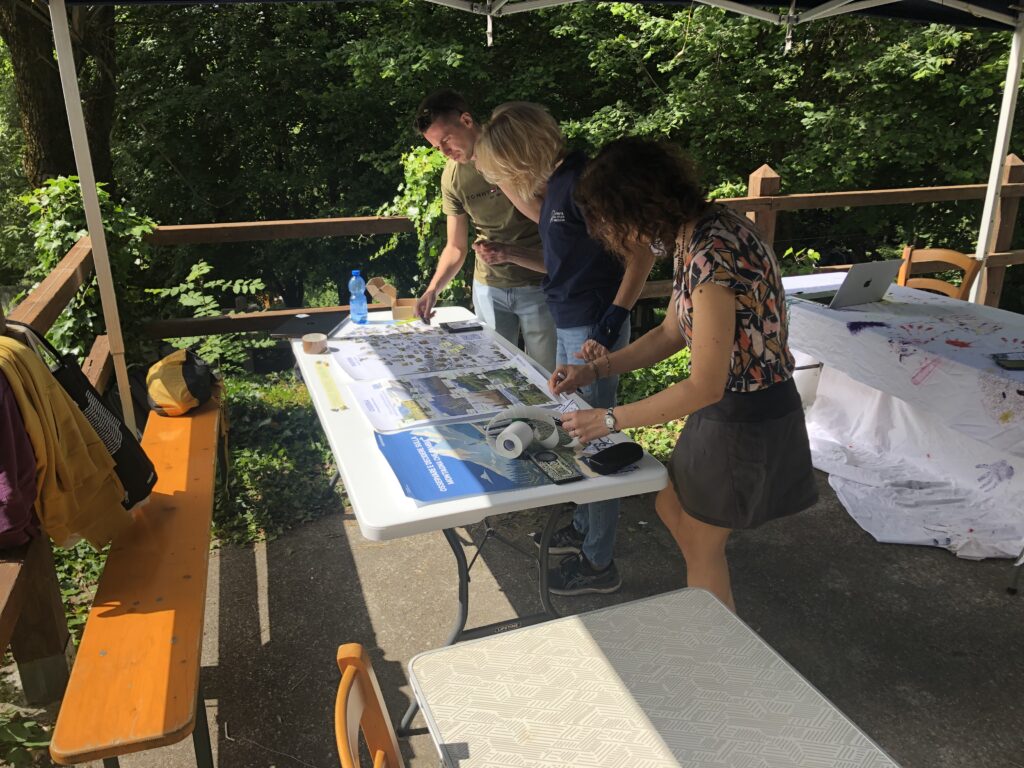
From May 30th to June 1st, at the Corpo e Montagna Festival held at the Casa del Parco Adamello in Cevo, the EU-funded NEUROCLIMA project set up a unique living lab. Surrounded by the rugged peaks of Adamello Park, researchers deployed participatory engagement tools to explore how local memory, regional identity, and community action can intersect to map a resilient future for Europe’s mountain territories.
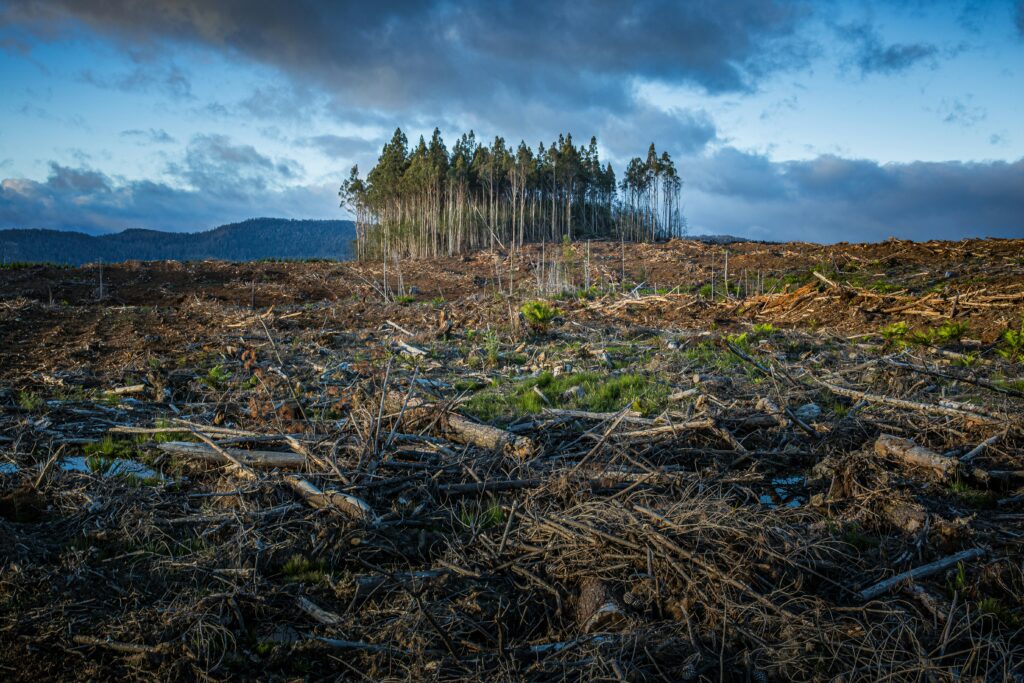
To understand the emotional weight of this pilot, one must understand the territory. The Adamello Park region has faced severe environmental and socio-economic compounding challenges over recent years. Most notably, the valley carries the deep scars of Storm Vaia (October 2018)—an extreme weather event that flattened roughly 14 million trees and destroyed 42,500 hectares of forest across northeastern Ital
Compounding this ecological vulnerability is a demographic one: rural depopulation. As young people migrate to urban centers, cultural milestones like the Corpo e Montagna Festival serve as critical interventions to strengthen community identity and foster vital discussions about the future of mountain livelihoods.
“Observe” (Osserva): Translating Emotion into Climate Data
Throughout the three-day festival, passing visitors approached the NEUROCLIMA exhibition zone out of curiosity. Welcomed by two project researchers, voluntary participants completed an initial behavioral baseline questionnaire before diving into a two-part interactive workshop.
The first exercise, titled “Observe” (Osserva), challenged the boundary between reality and perception. Participants were presented with eight images of mountain landscapes. Some were real media photographs of environmental transformations, while others were subtly generated using Artificial Intelligence. Armed with adhesive notes, citizens were asked to write down the immediate words, emotions, memories, or reflections that the visuals provoked.
The response was an outpouring of collective memory. Sticky notes flooded the boards, frequently repeating terms like “Vaia”, “devastation”, and “forest management”. Images of retreating glaciers sparked deep communal melancholy, while others elicited a profound sense of harmony and peace with traditional alpine pastures, grazing activities, and sustainable agriculture.
The tool proved a core NEUROCLIMA hypothesis: climate adaptation isn’t just a technical challenge; it is an emotional and cultural negotiation closely tied to landscape identity.
“Propose” (Proponi): Co-Designing the Future Alpine Horizon
If the first exercise mapped past memories, the second exercise, “Propose” (Proponi), gave citizens the tools to co-design the future.
Participants were handed a large, black-and-white canvas illustration of a mountain landscape. Their task was to build their ideal, resilient mountain ecosystem using a vast toolkit of illustrated stickers representing wildlife, local infrastructure, renewable energy technologies, slow tourism networks, community spaces, and agricultural practices.
The resulting collaborative collages revealed clear societal priorities for alpine governance:
- Eco-Preservation: Strong emphasis on slow, sustainable tourism, restoration of historic hiking trails, and biodiversity conservation.
- Coexistence: A desire to balance human infrastructure with wildlife habitats and traditional alpine agriculture.
- Social Spaces: The deliberate integration of community areas, highlighting that a landscape cannot be resilient if its villages are empty.
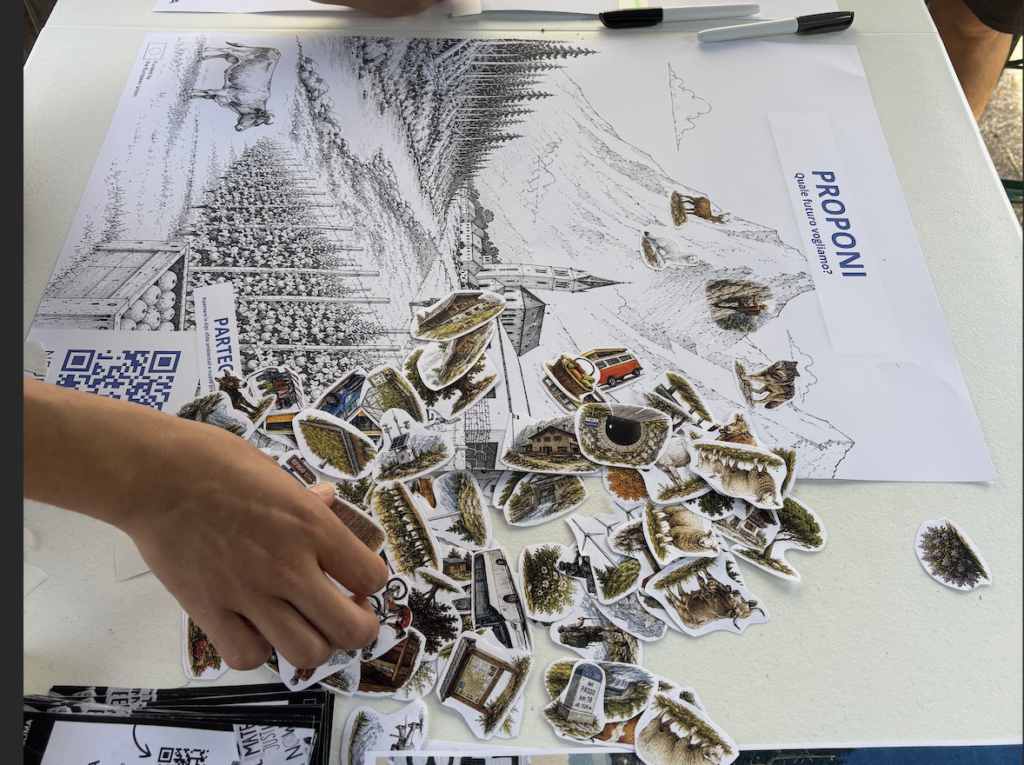
Interestingly, the “Propose” exercise brought a critical socio-political friction point to light: the role of renewable energy infrastructure. While many participants willingly placed wind turbines or solar grids on the canvas as necessary weapons against global warming, others expressed deep concern over how these installations might alter the cultural heritage and visual identity of the peaks.
This friction didn’t halt the exercise; instead, it opened up a constructive, democratic dialogue on the trade-offs of localized green transitions—the exact type of consensus-building the NEUROCLIMA project seeks to facilitate.
Cultivating Grassroots Agency
Before leaving the lab, participants completed a final questionnaire, giving researchers the data necessary to measure how interactive co-design shifts an individual’s sense of climate agency.
The Adamello Park pilot demonstrated that climate adaptation strategies cannot be dropped top-down onto communities from central offices in Brussels or Milan. To be relevant and effective, strategies must be grown organically from local soil—rooted in collective memory, respectful of landscape identity, and powered by active citizen participation.
By giving the people of Cevo a canvas to re-imagine their mountains, NEUROCLIMA is proving that while extreme weather events like Vaia shape our past, community collaboration will shape our future.