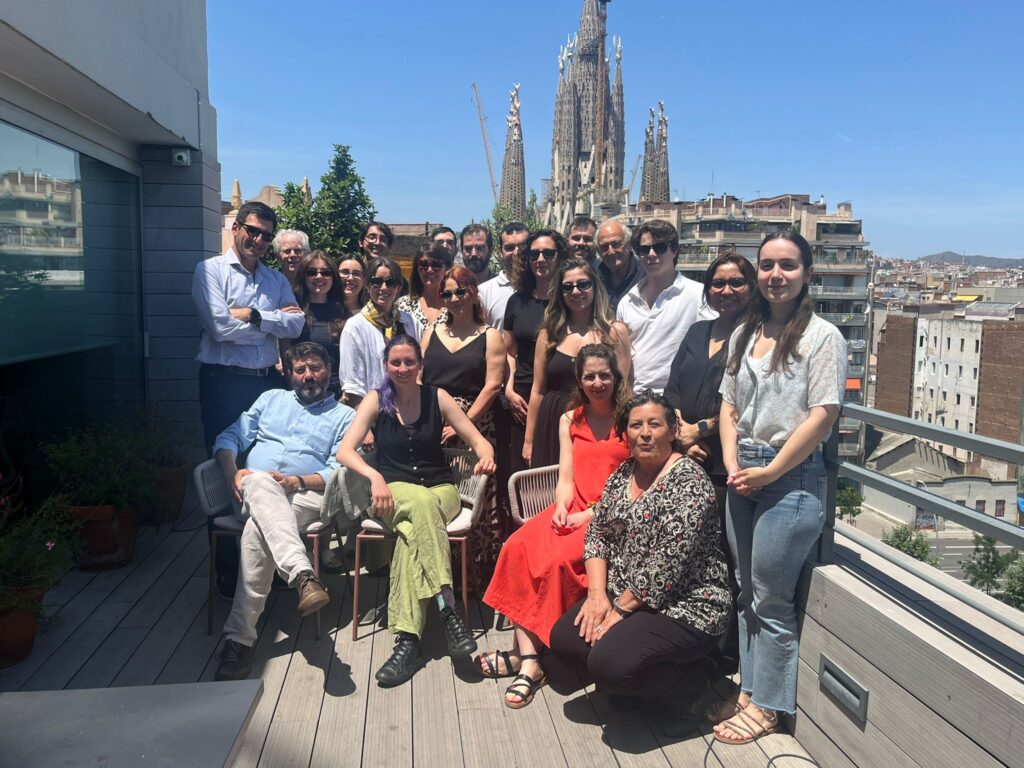
The NEUROCLIMA Consortium recently concluded its two-day consortium meeting in Barcelona, marking a significant step forward in the development of the project’s climate resilience framework.
Hosted by PredictBy, the summit convened an international network of researchers, data scientists, and developers. With the foundational phases of the project now complete, discussions focused on three operational priorities: finalizing backend data architecture, refining user experience (UX) for the project’s flagship AI applications, and evaluating ongoing field pilots across six European nations.
The meeting started with an overall assessment of our macro-level progress. Our lead partner, Politecnico di Milano, delivered a comprehensive overview of our active Tasks, Deliverables, and Milestones, confirming that all work packages are advancing on schedule to achieve our established KPIs.
Data Architecture
At the core of the project is a complex data challenge: bridging the gap between hard climate science and human behavioral patterns. Initial sessions focused on the architecture built to guarantee a seamless flow across the project’s diverse data sources.
The team at PredictBy presented a finalized data management framework designed to process complex behavioral data streams, public sentiment tracking, and shifting policy indicators. By structuring these varied inputs into an intuitive visual architecture, our engineers ensure that NEUROCLIMA’s analytical models operate on clean, real-time data pipelines.
AI-Driven Tools
A significant portion of the technical review was dedicated to Lens and Bots, the two primary AI-driven tools designed by the consortium to convert complex climate datasets into clear, actionable insights.
Participants engaged in rich working sessions with engineers and UX designers from ITML, the University of Oulu, Novelcore and the School of Design of Politecnico di Milano. The focus was user-centric: ensuring that complex climate related data can be easily navigated by non-technical stakeholders. The adjustments made during these sessions directly address user feedback from early testing phases, smoothing the path toward full-scale deployment.
Pilot Deployment
A major highlight of the meeting was the presentation by our partner CATAA, providing a comprehensive status update on the pilots currently rolling out across six countries. These initial deployments are actively engaging educators, students, youth workers, and community groups to evaluate how the tools perform in real-world educational and community settings. The coming weeks will see the launch of a new phase of pilots designed specifically to test the NEUROCLIMA framework and tools with policymakers, journalists, and content creators.
The initial feedback received from participants in these ongoing pilots is incredibly exciting, validating the current development trajectory and proving that the tools effectively meet the needs of target communities on the ground.
The meeting closed with a strategic discussion on the future societal impact of the project. NEUROCLIMA is being built to catalyze a systemic shift in how Europe responds to climate variables. The NEUROCLIMA framework is specifically tailored to empower five key stakeholder groups:
- Policymakers: Providing real-time climate research, media tracking, and social tipping points to inform and strengthen regulatory frameworks.
- Researchers: Offering open-access, structured scientific literature to foster multi-disciplinary climate change and societal impact studies
- Educators: Supplying accurate, real-world data and educational tools for climate literacy.
- Journalists: Streamlining access to research, policy and news content to enrich their informative coverage.
- Society at large: Demystifying climate science through accessible public tools and content.
The consortium departs Barcelona with clear milestones for the upcoming quarter, energized by the hospitality of our local hosts and the shared vision of our partners.
For regular updates on our progress and upcoming tool releases, follow the official NEUROCLIMA channels or subscribe to our project newsletter.