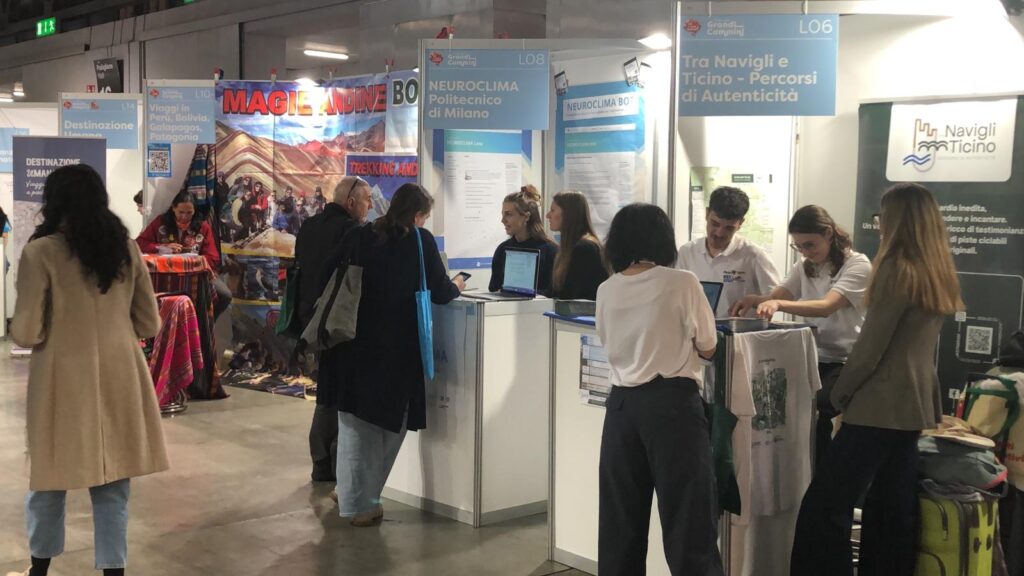
Anyone who has ever spent an afternoon lost in the bustling aisles of Milan’s “Fa’ la cosa giusta!” (Do the Right Thing!) fair knows the vibe. It is a space where you can find yourself locked in a passionate debate about sustainability with a complete stranger, standing between crowded school trips and organic food stalls, as if you’ve known each other for years.
It was exactly here that a team of researchers from the Politecnico di Milano decided to pull off a deceptively simple experiment. They weren’t there to preach, hand out dry academic brochures, or lecture the crowd. Instead, armed with a deck of playing cards and a digital platform, they set out to answer one of the most urgent questions of our time: How do we get everyday people to actually care about—and understand—the climate crisis without driving them into passive despair?
The answer, it turns out, may be hidden behind a QR code.
The Blind Choice
On a table at the university’s stand lay ten ordinary-looking playing cards. Each bore a single QR code. The hook? Every single card was linked to a completely different piece of media. Sometimes they were critical articles, like those from Greenpeace on the contradictions of the Games. Other times, videos, offering a more optimistic slant, such as pieces discussing sustainable heritage or green investments. There were journalistic analyses (Il Post, Avvenire, Euronews), mountain blogs that unfilteredly described what it means to play sports in a changing environment, and even political commentary on the “balance” of the Milan Cortina 2026 games.
The choice was entirely random. Participants drew a card blind. Yet, watching the crowd, the researchers noticed something fascinating. People didn’t just snatch a card; they paused. They hovered their hands, weighing the options as if this tiny, random decision carried massive stakes.
Once scanned, the narrative roulette began.
Some drew scathing investigations exposing the systemic environmental contradictions of hosting mega-sporting events in a warming world. Others unlocked optimistic video essays detailing green investments and sustainable legacy infrastructure. The content pool spared no perspective: rigorous investigative pieces at alongside raw, unfiltered dispatches from mountain bloggers witnessing the literal melting of their sport, and sharp political commentaries analyzing the complex economic balancing act of the Milan Cortina region.
After reading the article or watching the video, we asked participants to leave a comment on Deliberate, a tool on the Neuroclima platform designed specifically to gather public opinion on topics related to climate change. No votes, no right or wrong answers. Just a thought, even a brief one. This was the most revealing moment. Some wrote that they felt “conflicted,” some said they had never connected the Olympics to water consumption for artificial snowmaking, and some wondered why such large events are organized in places that are increasingly struggling to guarantee acceptable weather conditions. Some defended the Olympic machine, others openly criticized it. Everyone, however, understood that they were thinking in a new way. At the fair, it often happens that a
short piece of content sparks a question that had never crossed your mind.
And afterward? The post-survey
Once the Deliberate activity was completed, participants returned to us. They filled out the second questionnaire, and here, the change was evident.
Many said they felt more informed than before, and others said they better understood the difference between “climate information” and “contextualized information,” that is, information tied to a real, concrete case, close to their experience. And there were plenty of people who admitted they’d changed their minds on certain points or begun to doubt their initial opinion. This is precisely where a project like Neuroclima shows its value. In an era where social media conditions us to instantly double-tap or leave toxic commentary, Neuroclima aked for something else: an honest, nuanced thought. No binary upvotes. No right or wrong answers. Just a space to process. Neuroclima is not about convincing you of something, it’s about helping us think better.
As the data poured in, a striking pattern emerged. No one was speaking in slogans anymore. Because they had been handed a concrete, localized story instead of abstract global data, they were suddenly processing the climate crisis through a deeply nuanced, systemic lens. A significant portion of participants admitted that the exercise had forced them to eithe change their minds or begin questioning their long-held biases.
This is precisely where the real value of the Neuroclima initiative lies. Coordinated by the Politecnico di Milano and uniting 15 partners across Europe, this Horizon Europe-funded project isn’t trying to force-feed citizens predetermined ideas and pollicies. Instead, it is building the neural and digital architecture to help us think better about climate. It treats citizens not as passive consumers of news, but as vital stakeholders capable of wrestling with systemic complexity.
If the buzzing energy at Fa’ la cosa giusta! proved anything, it’s that climate fatigue is a myth. People -from the classroom to the activist frontlines- aren’t tired of talking about the climate. They are just tired of being lectured. Give them the right tools, put complexity back at the center of the table, and they won’t just engage; they will help rewrite the future.