
Global climate policy is built on macro-perspectives – the essential data models, satellite imagery, and international frameworks that allow us to track ecological shifts on a planetary scale. Yet, there is a complementary dimension of climate literacy that can only be unlocked by narrowing the aperture. When we ground global data in local geography, environmental changes transition from abstract statistics into shared human realities. This symbiotic relationship between high-level science and place-based experience was the driving force behind a recent field experiment at the Corpo e Montagna Festival in Cevo.
Organised by Politecnico di Milano, the lead partner of the NEUROCLIMA consortium, and facilitated by local trainer Veronica Vismara (PignaMentis), the initiative bypassed traditional seminar formats to test a more immersive methodology. The objective was to explore how climate memory is constructed, examining the intersection between physical landscapes, environmental recovery, and the diverse information pipelines that shape public consciousness.
The journey began at the Casa del Parco Adamello. Here, a diverse gathering of local residents, visitors, and regional stakeholders completed an initial questionnaire designed to map their baseline perceptions of environmental risk. With these frameworks established, the group set off on a guided walk toward Lampoma Farm—a mountainside enterprise that sat directly in the path of 2018’s devastating Storm Vaia.
The trek served as an active, physical bridge between historical documentation and current ecological reality. Moving through the mountain terrain allowed participants to directly observe the long-term, visible consequences of extreme weather on Alpine ecosystems. By witnessing how the topography, biodiversity, and regional livelihoods continue to adapt years after a single cataclysmic event, the landscape effectively became a living canvas for climate investigation.
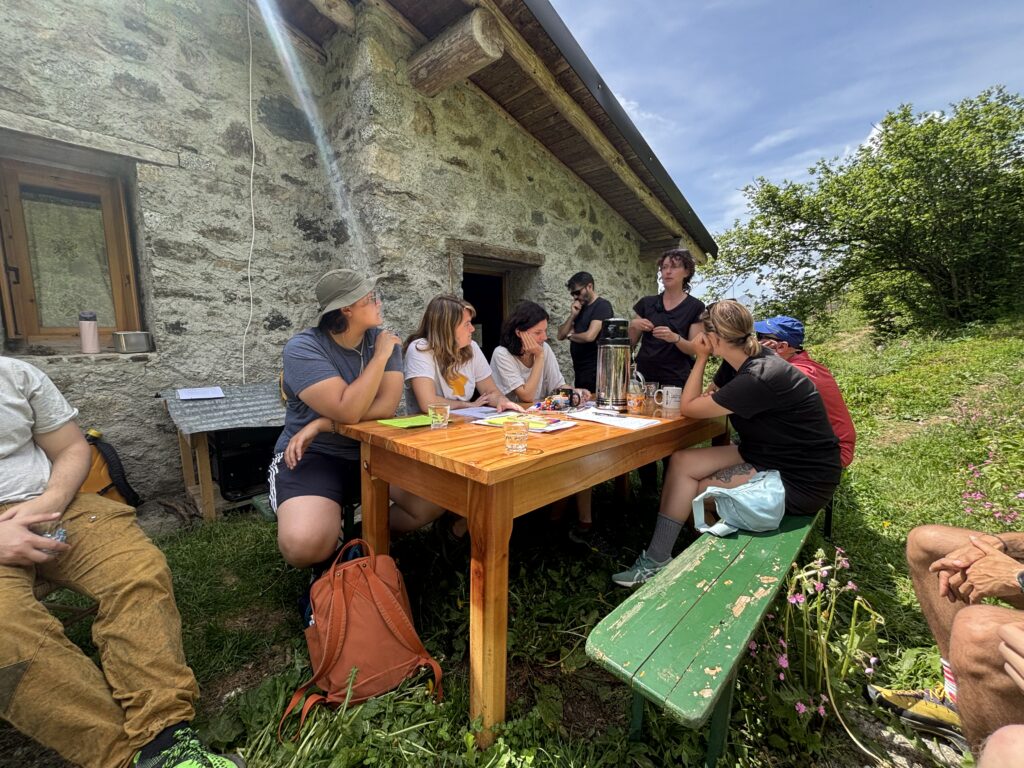
Upon arriving at the farm, the focus shifted to a collaborative inquiry into how the story of Storm Vaia is told and preserved. Divided into four working groups, the participants became environmental detectives, tasked with reconstructing the timeline and aftermath of the disaster. To highlight how different communication channels alter public perception, each group was assigned a distinct informational lens.
The first group stepped into the archives, analyzing local newspaper coverage from the weeks following the storm to isolate the immediate societal anxieties and journalistic narratives of the time. The second group engaged with the digital sphere, auditing public websites and institutional databases to track how official recovery efforts were presented online.
A third group focused on oral history, interviewing the manager of Lampoma Farm. This direct exchange yielded invaluable, first-hand testimony and generational local knowledge—the nuanced, human dimensions of adaptation that are routinely omitted from official white papers. Meanwhile, the fourth group explored the topic using the Neuroclima Bot, experimenting with an artificial intelligence-based information tool and evaluating its ability to provide relevant, accurate, and accessible information about climate-related events and adaptation strategies.
When the groups reconvened to cross-examine their findings, the juxtaposition of these different sources sparked a sophisticated debate on land management. Participants noted a fascinating divergence in regional recovery strategies across the storm-hit zones: in some areas, authorities pursued active, aggressive reforestation – introducing new tree species that sometimes altered the traditional ecological balance – while in others, decision-makers opted for passive natural succession, allowing the ecosystem to regenerate autonomously.
The power of narratives
The most profound realization of the day, however, centered on information literacy. By comparing their findings, the walkers saw firsthand how significantly the narrative of the exact same meteorological event shifted depending on the medium used to convey it.
Ultimately, the Adamello experiment proved a core tenet of the NEUROCLIMA mission: that building a climate-resilient future depends as much on the critical evaluation of information as it does on scientific research. By anchoring media analysis to the physical reality of an impacted landscape, the activity demonstrated that public opinion, policy debates, and collective responses are ultimately dictated by the quality of the stories we choose to trust.

